$254.50 billion is the projected AI market size in 2026, according to Statista, and it is expected to show an annual growth rate of 36.89% and is expected to reach around $1.68 trillion by 2031. The market will see tremendous growth and innovation continuously with AI becoming a prominent part of business operations.
That is a steep upward curve in the forecast of AI investment. It’s not just about having an automated workflow; it’s about how much competitive advantage a company gets from AI.
So, as an entrepreneur yourself, your next question naturally would be, How much is the AI development cost going to be, and which AI development company to approach?
You are at the right place to get deeper insights into artificial intelligence cost estimation. Let’s get started.
Key Takeaways
- 86% of small and medium-sized businesses (SMBs) report that AI boosts their revenue.
- 40% of companies reported a 10% reduction in logistics and transportation costs after implementing AI-powered predictive maintenance and route optimization.
- AI-driven SMBs have experienced a 107% year-over-year increase in e-commerce revenue attributed to AI-powered channels.
- Collaborating with the right AI software development company would reduce the AI development cost by 70%.
Let Coherent Solutions Estimate Your AI Development Cost
Table of Contents
How Much Does it Cost to Build an AI? A quick analysis
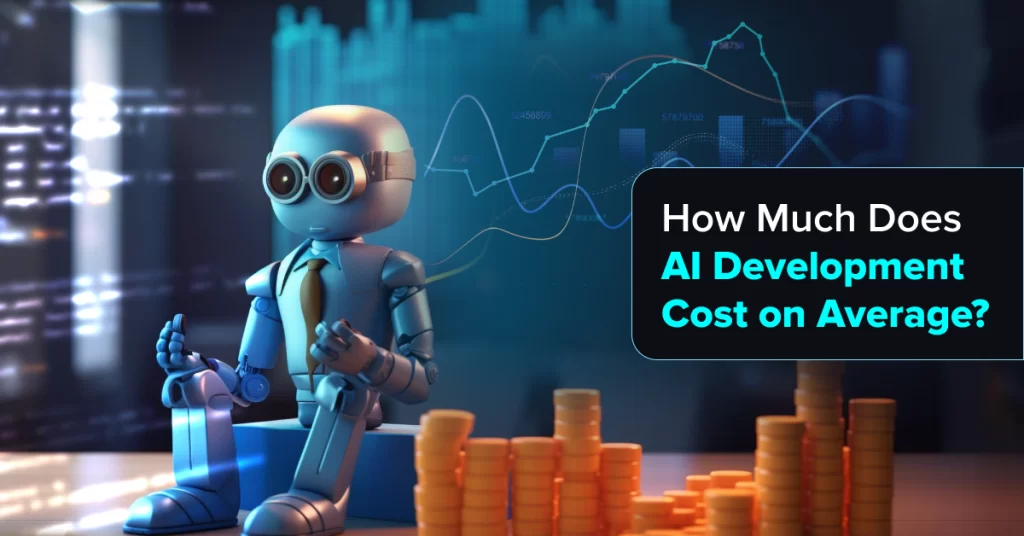
AI pricing typically ranges from $5,000 to $500,000, depending on the complexity, features, and scale of your project. Simple AI solutions that have limited functionality fall under low-end, from $5,000 to $25,000. Advanced systems requiring custom algorithms, integrations, and ongoing support fall under the higher-end, from $100,000 to $500,000.
The numbers can be daunting. But trust me, even the major AI software development companies are feeling the heat.
For example, OpenAI had been experiencing astounding income growth by collecting $300 million per month. But rapid expansion always comes with uninvited consequences. In October, the company announced that they are looking for investors who could bring in $7 billion to compensate for its loss involved in the cost of running its services, according to a report from NY Times.
The cost to build an AI can be challenging for any company, especially if you are a startup or a mid-size enterprise. Now, let us take you through an in-depth analysis about the cost so you can prepare beforehand and save your pocket from draining out.
| Industry | Common AI Software / Applications | Average AI Development Cost |
| Healthcare | ● Basic AI healthcare tools: appointment scheduling chatbots, AI-driven symptom checkers (like WebMD chatbot) ● Advanced AI healthcare solutions: Drug discovery platforms using deep learning. ● Customized AI solutions: A custom natural language model to process clinical notes. | ● $50,000 to $500,000 ● $10 million ● 30–40% higher than pre-built solutions. |
| Banking and Finance | Fraud detection systems, credit scoring AI, robo-advisors, and algorithmic trading bots. | $40,000 to $400,000+ |
| Retail & eCommerce | Recommendation engines, dynamic pricing tools, chatbots AI application development, and demand forecasting models. | $50,000 to $250,000+ |
| Education | AI-powered lesson planning, teacher assistants and chatbots, voice-to-text solutions, and adaptive parental guides. | $5,000 to $100,000+ |
| Logistics & Transportation | Route optimization, autonomous vehicle AI, warehouse automation. | $40,000 to $70,000+ |
| Energy & Utilities | Smart grid analytics, energy consumption prediction, and equipment monitoring. | $400,000 to $700,000+ |
| Entertainment & Media | Content recommendation engines, deepfake technology, and AI-based video editing. | $8,000 to $150,000+ |
| Human Resources | AI recruiting tools, resume screening, payroll, and performance management. | $75,000 to $500,000+ |
🎯 Project Complexity-Based Cost Breakdown
- Entry-Level Projects: $25K–$60K for basic, rule-based AI.
- Custom AI Solutions: $60K–$150K for ML-powered recommendations or analytics.
- Advanced Systems: $150K–$250K+ for deep learning, NLP, or computer vision apps.
🎯 Other cost influences include
- UI/UX design – Simple screens cost less; interactive dashboards and animations add more.
- Team expertise & location – Global hourly rates vary (India: $30–50/hr, USA: $100+/hr).
- Data needs – The more data your system needs to train on, the more infrastructure you’ll pay for.
This means you should first clarify your use case and budget range before approaching an AI tech partner.
Get No-obligation Cost Breakdown from our AI Architects
Factors Influencing AI Software Development Cost
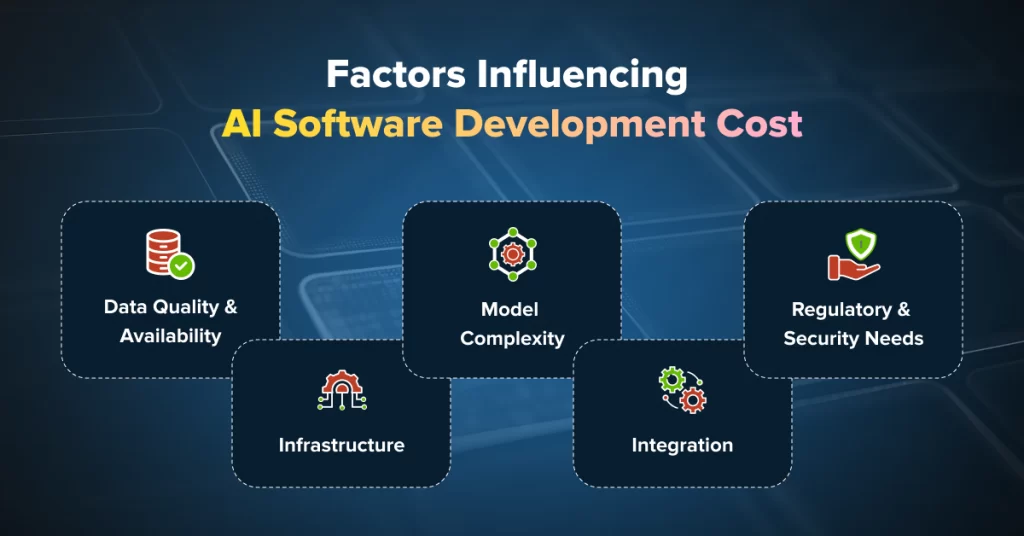
Common factors influencing AI cost are
- Data Quality and Availability
- Model Complexity
- Integration
- Regulatory and Security Needs
That said, the cost of developing AI isn’t one-size-fits-all. So, how much does it cost to build an AI system considering these common factors?
Here is a practical breakdown of common factors that drive the cost of implementing AI in business.
✅ Data Quality and Availability
The performance of your AI application completely depends on the quality of data. This is where the data is ensured to be clean, structured, and accurately labeled.
More often than not, this stage is the most time-consuming and expensive. It takes up to 30 to 40% of the project budget, which makes it a major factor influencing the cost of AI development.
Typical steps include:
- Data Collection: This involves gathering relevant datasets. The most common places where data is collected are from internal sources like CRM, ERP, IoT sensors, external APIs, public datasets, or purchasing industry-specific datasets.
Example: An e-commerce business gathers data from its CRM, stock levels from ERP, and browsing behavior from its website analytics to train its recommendation engine.
- Data Cleaning: Removing incomplete data, duplicate entries, filling missing values, and fixing errors.
Example: A hospital would cleanse its data by deleting its duplicate files, filling gaps in patient demographics to train an AI diagnostic tool.
- Data Labeling: Tagging or annotating raw data so that the AI model can recognize patterns and eventually learn from them.
Example: Marking spam vs. non-spam emails, tagging faces in images.
- Data Augmentation: Expanding datasets by generating synthetic data.
Example: Generating extra speech samples for voice assistants
✅ Model Complexity
Model complexity defines the depth of algorithms, training data, and processing power needed, i,e: how sophisticated your AI software is going to be. The more layers and data it needs, the more time and resources it takes to develop.
This directly impacts AI software development cost. The higher the complexity models, the longer the development cycles and specialized talents.
- Simple models, like a recommendation engine or a keyword-based chatbot, are cheaper to develop and take shorter development cycles.
- High complexity models like computer vision systems or image recognition, or NLP require massive datasets and expensive infrastructure costs.
This is why the question, “How much does it cost to develop AI software?” never has a simple fixed answer. It always varies based on the model complexity.
✅ Infrastructure
Infrastructure is a term that covers servers, storage, and cloud platforms that are the foundation of AI development. Whatever type of infrastructure you choose, it has a major role in influencing the AI development cost, and here are some examples.
- The AI-compute costs rise with complex neural networks, deep learning models that require large datasets, or projects involving computer vision.
- Companies often invest in a hybrid approach, which combines both on-premise servers with cloud platforms for a balance of high performance and data protection.
- Another important factor is tech stack selection. It involves choosing the right mix of programming languages and frameworks. This reduces rework and minimizes integration issues. When you choose the wrong tech stack, it lengthens project cycles and increases maintenance costs.
As an enterprise owner, think of infrastructure as a long-term investment that future-proofs your AI system and scales as the workload increases.
✅ Integration
Integrating AI into existing systems heavily depends on the existing system architecture and business objectives. Projects that require a higher level of customization and integration significantly increase AI software development costs.
When adding AI to a current product, watch out for potential cost risks:
- Cloud computing costs rising faster than expected.
- Additional compliance and security requirement expenses.
- An AI model failure leading to inaccuracy.
How to reduce risks:
- Conduct budget projections before full rollout.
- Begin with a small dataset before scaling up.
- Monitor AI performance consistently to prevent performance decay.
Regulatory and Security Needs
AI systems must meet data privacy requirements by adhering to standards like GDPR or HIPAA. Strong cybersecurity measures, such as encryption, authentication, and threat monitoring, are also to be implemented.
Maintaining fairness and reducing unintended bias by regularly auditing datasets is non-negotiable. Incorporating these practices contributes to the cost of AI development.
As a business owner, make sure to implement these regulations from the outset to avoid penalties, maintain trust, and ensure your AI software produces reliable and unbiased results.
10 Tips on Cutting the AI Development Cost
Building or integrating AI for your business doesn’t always have to break the bank. By optimizing your infrastructure and reusing your existing frameworks, you can reduce the costs involved. Here’s what it takes:
- Go for open-source tools like PyTorch or Keras to save on licensing fees and speed up AI development.
- Kickstart projects with pre-trained models to reduce training costs by up to 50%, tailoring them to your business needs.
- Go cloud-based for AI services (AWS SageMaker, Azure AI) to slash infrastructure expenses by up to 30%.
- Adopt Agile practices and optimize data collection to avoid rework, shorten development cycles, and maintain model accuracy.
- Make smart choices with talent, outsourcing, AutoML tools, MVPs, and operational monitoring to keep your budget realistic and efficient.
Also, do a thorough artificial intelligence cost estimation, as this gives you a clear picture of resource allocation and potential savings. Thoughtful decisions keep the cost of AI development under control while maintaining high-quality outputs.
Let’s take a deeper look at the strategies to optimize AI development cost in the following sections and see how these approaches can make a real difference for your business.
Curious to See How our Architects Can Cut AI Dev Costs by 20–30%?
1️⃣ Use Open-Source Tools
Using open-source AI tools such as PyTorch, Keras, and scikit-learn provides a cost-effective and reliable foundation, as they are constantly tested and optimized by the developer community worldwide.
Even large-scale AI platforms like ChatGPT which gets over 4.61 billion monthly visits and 2.5 billion prompts each day, depend on similar open frameworks. This proves that open-source tools can drive innovation for businesses of all sizes.
These tools lower the cost of implementing AI in business as they remove the need for licensing fees and shorten the development cycles. They also have ready-to-use libraries and strong community support that help teams deploy faster and focus on customizing models rather than building from scratch.
So, how much does it cost to build an AI with open source tools? It depends, but studies show that without open-source collaboration, companies would spend nearly 3.5× more to build the same systems. This means open-source development can substantially reduce the cost of AI development while encouraging faster innovation and scalability.
This makes open-source tools the best option for startups and businesses with limited budgets.
2️⃣ Start With Pre-Trained Models
Pre-trained or pre-built models are ready-made AI systems that are trained on massive datasets. You can easily tweak them to adapt to your business needs.
This cuts down the cost of developing AI, since you are only going to pay for fine-tuning rather than investing in full-scale AI model training. In fact, startups can reduce AI development costs by 50% using pre-trained models.
Example: An e-commerce company can start with a pre-trained recommendation engine like TensorFlow Recommender and just add their inventory data to it. This approach keeps the budget lean since the user only has to pay for the resources consumed and not for building a model from scratch, and for data procurement.
So when you ask yourself, “How to optimize artificial intelligence development costs?” figure out what existing work you can reuse, and look for pre-trained models that give you a head start.