
AI is no longer a futuristic concept. By now, almost 800 million people use ChatGPT and Gemini for quick answers, brainstorming, and problem-solving. These GenAI models are undeniably powerful but they lack context and autonomy.
Ask ChatGPT to check your flight time, and it won’t have an answer unless you fill in the details. AI agents have filled this gap, which has increased its demand in the market. If you are wondering how to build an AI agent, you are on the right track.
So, what is an AI agent?
An AI agent is a software that can plan, take action, and even upgrade on its own from previous experiences. AI agents are excellent assets for your business if you run an online store that requires customer service or if you are a SaaS provider who is having difficulty in organising client meetings and follow-ups.
Here’s how creating an AI agent might be beneficial:
- A McKinsey survey has found that AI reduces operational costs by nearly 30%.
- AI agents remember the context and provide customized experiences to each customer.
- Stay ahead of your rivals by delivering quick and customized responses relentlessly.
- Transform workflow data logs into actionable insights to make smarter data-driven decisions.
So, now it’s clear that AI agents are helpful for any business. But, how to develop an AI agent? How much does it cost for AI agent development? If these questions are bombarding your mind, this blog will answer all your questions. Read on!
Key Takeaways
- A Forbes study states that the global AI agent market is expected to reach $50.31 billion by 2030, which is a 45.8% CAGR increase from the $5.40 billion of 2024.
- A Gartner report states that 40% of enterprise apps will have task-specific AI agents, which is at 5% in 2025.
- A stat from Market.biz shows that AI agents help programmers to complete tasks 126% faster.
- A McKinsey study shows that AI agents speed up tasks by 40 to 50% and reduce costs by 40% while keeping the output quality enhanced.
Choosing the right Agentic AI development company will help you to create a scalable and cost-effective AI agent.
Looking for a Reliable Partner to Build your AI Agent?
Table of Contents
6 Types of AI Agents That Automate Your Business Operations with Examples
There are six major types of AI Agents. They are simple reflex agents, model-based reflex agents, goal-based agents, utility-based agents, learning agents, and multi-agent systems. Understanding these types helps you to choose the right AI agent based on your specific needs and goals.
These AI agents are classified based on their intelligence level, decision-making skills, and how they interact with their surroundings. When businesses research how to build AI agent, these insights are important to choose the right type.
Companies that are looking to learn how to create an AI agent must know about the types of AI agents. So that they can choose the right one based on their technical complexity and costs. We have listed the main types of AI agents that have their own strengths and applications.
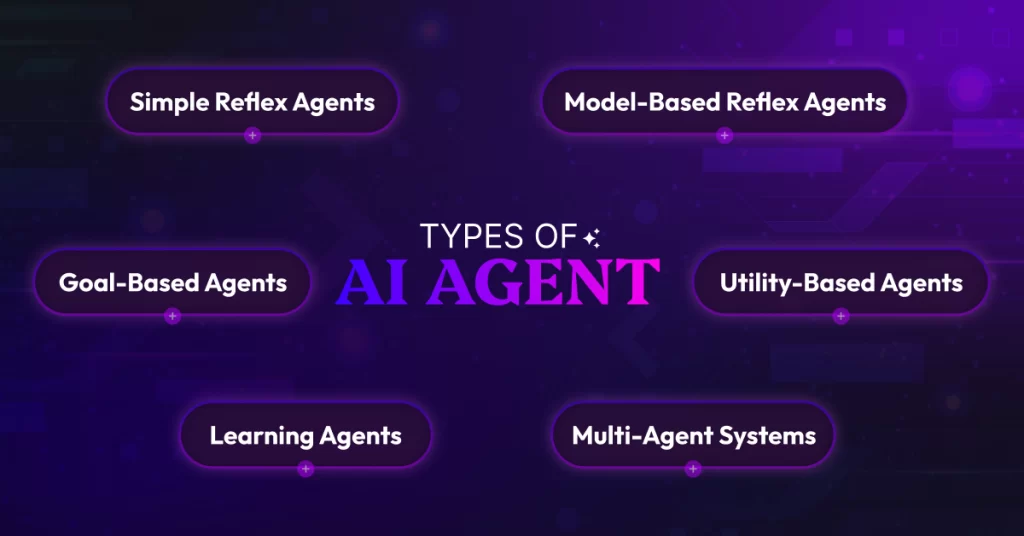
👉 Simple Reflex Agents
This is the most basic type of AI agent. A simple reflex agent gives a direct response based on the current input without thinking much about the past experiences or future complications. Their behaviour is influenced by predetermined condition-action rules that specify how to respond to certain inputs.
Though their complexity is limited, this method makes them practical and easy to design especially in situations where there are only a few options to consider. Businesses that depend on repetitive tasks and condition-based business processes mostly in static environments can build AI agents of this type.
Example: An automated sprinkler system is a simple reflex agent that turns on automatically when smoke is detected.
👉 Model-based Reflex Agents
Model-based reflex agents are the advanced version of simple reflex agents. These models still rely on condition-action rules to make decisions but they also create their own internal model.
They are more flexible than simpler agents because they are capable of dealing with situations where the context must be retained and applied to decisions in the future. These agents are appropriate for environments in which the present condition cannot be fully observed with just data sensors.
Businesses that operate in dynamic environments where past events are essential to make informed decisions can create AI agents of this type.
Example: Smart home security systems use internal models of regular household activity patterns to differentiate between ordinary activities and potential security threats.
👉 Goal-based Agents
Goal-based agents use an active and goal-based approach to solve a problem. They are created to achieve certain goals while considering the long-term effects of their activities.
Unlike reflex agents that operate based on rules or world models, goal-based agents plan sequences of behaviors to achieve desired results. They apply search and planning algorithms to identify activity sequences that lead to their expected outcomes.
These planning capabilities enable goal-based agents to manage complex tasks that need thoughtful consideration and strategy. Understanding how to build AI agent with these goal-oriented traits allows firms to develop intelligent systems that can proactively navigate dynamic situations and continuously progress toward specific goals.
Example: The self-driving cars which have the destination as its goal and make decisions all through the journey to reach the goal as safely and efficiently as possible.
👉 Utility-based Agents
A utility-based agent is capable of making decisions by evaluating every outturn for its actions and choosing the one that amplifies total utility. This lets businesses to make better decisions especially when there are multiple options to choose from.
These agents perform effectively in complex and dynamic scenarios where simple decisions based on objectives might not be sufficient. They aid in balancing multiple objectives and adjusting to changing circumstances, which leads to more flexible behavior.
Businesses that operate in decision-intensive environments with multiple objectives can build AI agents of this type to achieve their goals efficiently.
Example: Traffic management systems that analyze multiple factors like traffic data, accident reports, road blocks, etc and adjust signals accordingly, ensuring a smooth travel.
👉 Learning Agents
Learning agents improve its performance by understanding its environment and learn from its experiences. Other AI agents depend mostly on existing protocols, whereas learning agents continuously adapt their behavior based on user feedback. This helps businesses to function better in situations that are dynamic and surprising.
Learning agents are effective in situations where the right path of action is uncertain and must be found with experience.
Example: Streaming platforms like Netflix can create AI agents that discover the users’ interests and give content recommendations based on that for a better experience.
👉 Multi-agent Systems
A multi-agent system consists of several autonomous agents interacting in a shared environment. It acts independently or collaboratively to achieve individual or collective objectives.
Companies that wonder how to build a AI agent to solve complicated issues in real-world situations can opt to build multi-agent systems. These agents break down even the complicated tasks into smaller and more manageable subtasks. Higher-level agents prioritize extensive goals while lower-level agents perform more specific jobs.
Example: Understanding the different types of AI agents and selecting the right type of AI agent is a crucial step in the process of knowing how to develop a AI agent that is profitable and efficient.
Thinking About AI Agents for Your Business Operations?
Step-by-Step Guide on How To Build An AI Agent
Developing an AI agent requires ample research and planning to make sure that the AI agent meets specific business goals. According to Grand View Research, the AI agent market size worldwide in 2024 was USD 5.40 billion and is expected to reach USD 7.60 billion in 2025, showing how rapidly this space is growing and why businesses must approach development thoughtfully.
It needs a well-structured approach, not just the simple integration of large language models. Below, we have discussed the steps involved in creating a successful AI agent. So, continue reading to know.
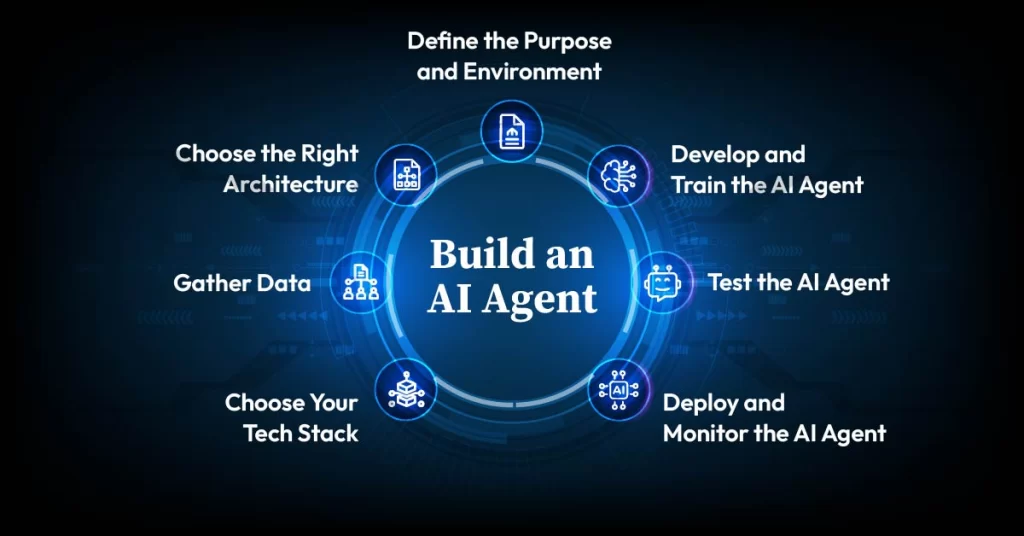
1️⃣ Define The Purpose And Environment
First, make sure to identify the exact environment in which you want to place your AI agent. Do you wish to incorporate the AI agent into an app, website, or other system? This will help in clearing the way for compatibility after the implementation stages.
Once the environment has been specified, determine the tasks and functionalities that the AI agent must perform. This will vary depending on the field or industry.
Then, ascertain the responsibilities of the AI agent. List the tasks or issues you would like the AI agent to resolve. Do you need it to respond to consumer queries, assist users with online shopping, or give business information? Your AI agent’s functions should be in line with the needs it is designed to meet.
2️⃣ Choose The Right Architecture
The next stage is to choose an architecture which is the blueprint that defines how your agent analyzes information and takes action. The architecture you choose is typically determined by the type of AI agent you wish to create.
Nowadays, the majority of enterprise-level AI agents use:
- Rule-based architecture to perform predictable tasks such as classification and routing.
- Goal-based architecture is for large-scale automation and decision-making.
- Learning-Based Architecture to create adaptive platforms that improve continuously with data.
This choice is important because the right architecture ensures your AI agent is functional and cost-effective. Since every business has unique work functions, partnering with an AI agent development company can help you create an AI agent for your business.
3️⃣ Gather Data
Just like a student learns from textbooks, an AI agent learns from data. If you don’t have the right data sets, your AI agent will be invalid. The data gathered should be reliable, significant, and large. If the data is inaccurate or of low quality, your AI agent can make blunders that are unimaginable.
Data can be obtained from the following sources:
- Internal Data: This refers to the data collected from your business operations such as sales reports, customer information, financial reports, and many other records.
- External Data: This includes data from the public domain, commercial partners, and purchased datasets.
- User-generated Data: This includes user data that is gleaned from social media posts, website interactions, and product reviews.
The data needs to be preprocessed after it has been collected. This covers detecting irregularities, dealing with missing data, and confirming data consistency. The process guarantees that you establish a strong and reliable basis for the deployment of your AI agent.
4️⃣ Choose Your Tech Stack
The next step is to select the appropriate programming language, framework, and libraries. It must be chosen based on how your AI agent needs to understand text, analyze visuals, or make predictions.
| Layer | Tool/Platforms | Best For |
| Programming languages | Python, Java, C++ | Python for ML/AI libraries; Java/C++ for performance-heavy apps |
| AI Libraries & Frameworks | NLTK, spaCy, TensorFlow, PyTorch, OpenCV, DeepSpeech, Rasa | NLTK, spaCy for Natural Language Processing, TensorFlow, PyTorch for ML & Model Training, OpenCV for Computer Vision technology, DeepSpeech is for speech recognition, and Rasa is for web-based platforms |
| LLM & Agent Frameworks | LangChain, LlamaIndex, AutoGen | For building context aware AI agents |
| Cloud Platforms | Google Vertex AI, AWS SageMaker, Microsoft Azure AI | Vertex AI for holistic AI services, AWS SageMaker for existing AWS users |
| APIs & Integrations | OpenAI, Anthropic, Hugging Face | Access to 100s of pretrained models |
| Databases | PostgreSQL, MongoDB | Handling structured and unstructured data |
Don’t Just Know About AI Agents—Deploy Them
5️⃣ Develop and Train The AI Agent
Now that you are ready with your essential tools and technologies, you can start building your AI agent. First, start developing the brain of the AI agent. It is the learning model with a set of rules that instruct your AI agent to act as per input in various situations.
Initially, the agent can recognize names, dates, and other elements in text. Then it aims to understand the sentence structure. After the AI agent has identified words and sentences, you must initiate conversations.